
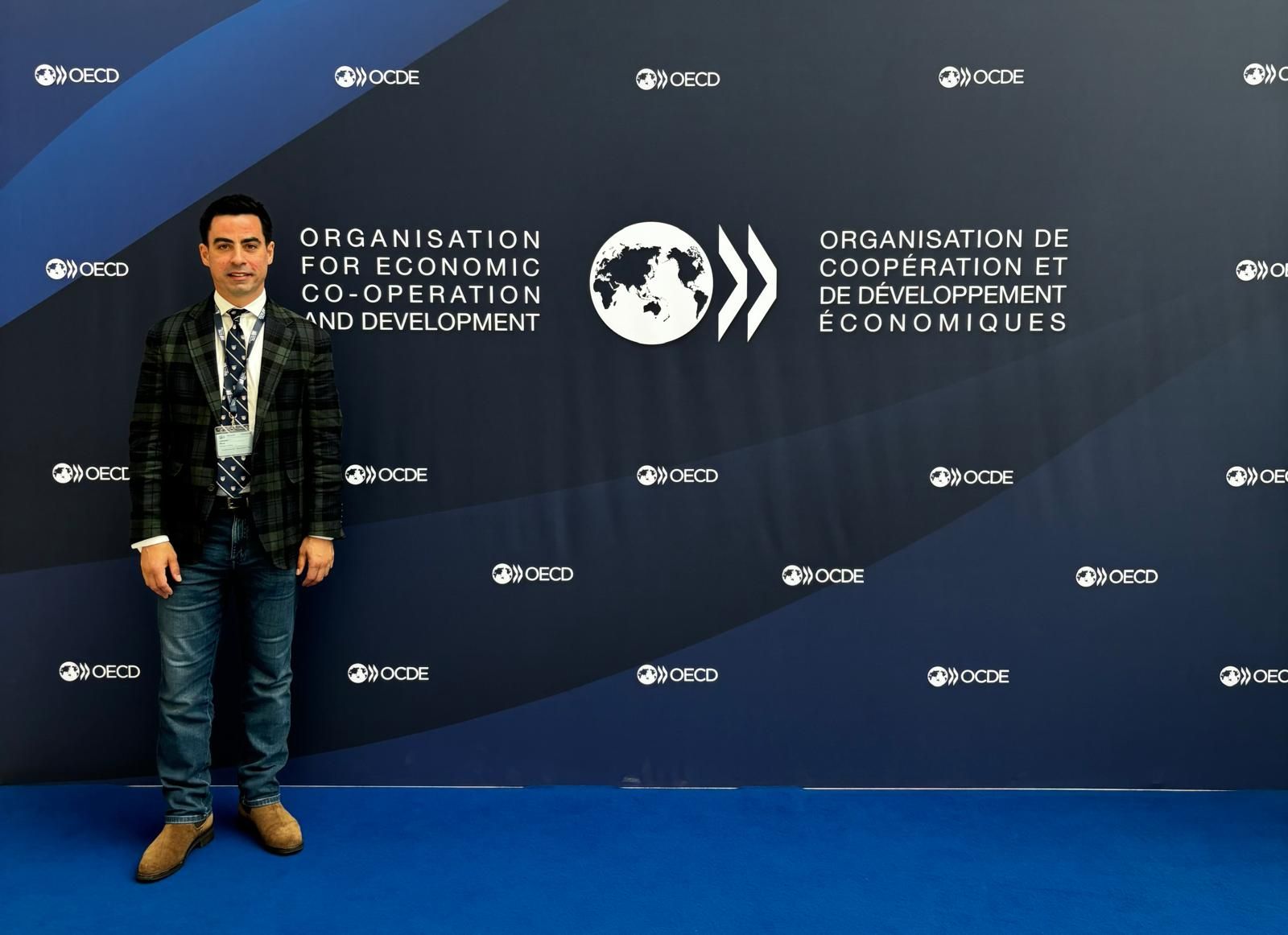
Counting who matters most: setting a new agenda for mapping talent, participation and careers in research and innovation
Plenary, Tuesday 15 September, 11:40 to 13:00. Mikey Creane, Chair, ICoRSA. Moderator: Gillian Golden, OECD.
Round one
Where do you see the biggest disconnect between what policymakers and institutions seek to measure and what researchers themselves need to know to build successful, sustainable careers? What do you see as the biggest evidence gap, from the perspective of researchers?
1. The question researchers actually ask
Thanks Gillian. I would start with the question researchers actually ask, because it is not the question our data answers.
They rarely ask how many researchers there are. They ask what my prospects are, and what my career will look like.
That is the disconnect. Our systems are built to answer the questions the system asks. Do we have enough researchers? Are they productive? Are they moving between countries and sectors? So we count how many there are, full-time equivalents, PhDs awarded, publications, and movements across borders.
Those are useful questions for a ministry. They do not answer the question that matters to an individual researcher, which is simply this. What does all of that mean for me, and should I stay in research or not?
I will give you three gaps. The first is not about finding researchers. It is about how we define them.
2. The researcher we do not see
Take a researcher in her mid-thirties, on her fourth short-term position, paid by a fellowship rather than an employment contract. In some countries, including in Europe, she is not counted as an employee. That can mean no employment record, and in some cases no parental leave and no social insurance. It can even make it hard for her to prove her income to a landlord or a bank.
We count her publications. We count her movements. But we lose sight of her as a worker.
We are not failing to find her. Our systems simply do not know how to count her. Until our statistics can separate a contract from a fellowship from a stipend, we will keep missing the people whose working conditions concern us most.
3. The career, not the snapshot
The second gap is that we measure snapshots, but researchers live a whole career. An institution sees four one-year contracts as four hires, or as one full-time equivalent. The researcher lives four separate moments of uncertainty.
We do not usually measure that. We do not track how many short contracts someone has had in a row, or how many researchers are still on temporary contracts in their thirties and forties.
In Canada, the average age of a postdoc is now just under thirty-five. That means people spending much of their thirties wondering whether a permanent research job is ever going to come. No official statistic would have told us that.
I know it because the Canadian Association of Postdoctoral Scholars has tracked postdocs since 2009. Not a national statistical agency. An association of postdocs, doing this in their own time.
Now, I know what the statisticians in this room are thinking when I quote figures like those. Self-selected samples, volunteer-run, not representative. And you are right. That is exactly my argument. The best available evidence on the working conditions of postdoctoral researchers comes from surveys that postdocs run themselves, because no statistical system produces it.
I would be delighted to be corrected by a better dataset. There isn’t one.
4. Where researchers go
The third gap is what happens after research. Most people who complete a PhD build their careers outside universities. That is a normal career outcome, and it should not be treated as a failure. But we only see people while they are here. When they leave, we lose sight of them, and then we call it attrition.
I would guess that quite a few people in this room did a PhD, perhaps a postdoc, and now work in statistics or policy. You are counted in the data for what you do now. The data does not tell us that your career today is the outcome of a research career. That is the gap we need to close.
5. What I would put on the agenda
So if I name one evidence gap above all others, it is this. We can describe the research workforce. We cannot describe a research career.
Three things would change that.
First, clearly separate contracts, fellowships and stipends. If we do not know how someone is employed, we do not really know what the research workforce looks like.
Second, count contracts and their sequence, not just people, and measure how long it takes to move from a PhD to a permanent or continuing position.
Third, follow people when they leave, with their consent, because where researchers go tells the next generation what a research career actually looks like.
We count researchers while they stay. We need to count what happens to them when they go.
I saw some good work on exactly this yesterday, in the session moderated by Luísa Henriques. Let us keep going with it.
Round two
1. Framing: measure the people behind R&D
I’ve three points: how to frame this, on cost, and risk.
On framing, I would stop calling this a request for money for statistics. That is something finance ministries are trained to say no to. I would say instead that we are trying to measure the biggest input into the research system, which is people.
Global R&D spending reached around 3.8 trillion dollars in 2024. About 2.3 trillion of that was in the OECD area. And the largest part of that spending is people.
We measure the equipment. We measure the buildings. But for people we still use indicators that cannot tell us whether someone is on their first contract or their fifth.
No ministry would accept that level of reporting for any other asset of that size.
2. Cost: count what already exists
On cost, NCSES [National Center for Science and Engineering Statistics] gives us probably the best national picture of a science and engineering workforce anywhere, and it does that for tens of millions of dollars, against national R&D spending of about a trillion.
We already invest huge amounts in research. Spending a relatively small amount to understand the people doing that research is a sensible investment. It helps us identify problems early and make sure the research workforce is sustainable.
And my advice is simple. Do not build a new survey. Get researchers counted in the systems that already exist and are already paid for.
ISCO is being revised now, with the aim of having it ready for the 2030 round of population censuses. If research roles become more visible in that revision, countries can produce far better evidence on research careers through surveys they are already running, instead of building something new. Better evidence, without another reporting burden.
The same applies to the ERA Act. If it introduces a model researcher contract, four things could be standardised from the start. Contract type, contract length, employment status, and funding source. Those fields cost almost nothing to add now. They would be almost impossible to add later.
3. Risk: who owns the evidence
On risk, the real issue is what happens when governments do not hold reliable data of their own. We become dependent on data we do not control. We heard from commercial platforms this morning, and their data is genuinely valuable. It can show us things public systems cannot. But it is commercial. It may not cover everyone we need to understand, and access can change over time. Public systems need to provide the foundation, with commercial data adding to it.
If I had to give one argument to a finance ministry, it would be this. Measurement protects the investment you have already made. Europe has put close to 900 million euro behind Choose Europe, and there are now more than a hundred national and regional schemes on top of that. We still have no reliable way of knowing whether the people we attract are here five years later. If we cannot show these schemes are working, they will be much harder to defend in the next budget.
So the line I would leave with them is this. You can afford to measure your researchers, or you can afford to keep replacing them. And replacing them is considerably more expensive.