A new model international instrument on artificial intelligence has been published for global consideration. Prepared by Dr Rosarii Griffin, ICoRSA’s Director and a researcher with a doctorate from Oxford and a Fellow of the Royal Society of Arts, the document sets out 42 articles across seven chapters. It is titled A Global Charter for Artificial Intelligence: Shared Principles for a Shared Future.
The text is not an official United Nations document. It has not been negotiated or endorsed by any government. Dr Griffin states this clearly on the opening pages. What she offers instead is a drafting model. A template. Something that states, international organisations, civil society and the private sector can pick up, argue over and improve.
The timing is notable. Governments are still feeling their way towards AI rules. The European Union has its AI Act. The Council of Europe has a framework convention. UNESCO has its recommendation on AI ethics. But there is no single global treaty. No common floor that applies everywhere. Dr Griffin’s charter tries to fill that gap.
What the charter proposes
The central argument is simple. AI must serve human dignity, peace, human rights and the common good. That sentence appears in the explanatory note and echoes throughout the text.
The charter is built on five design principles. First, a universal floor of minimum duties that applies to both public and private uses. Second, risk proportionality, meaning obligations grow with the scale and reversibility of potential harm. Third, rights and remedy for affected people, including notice, explanation and human review. Fourth, global equity, with capacity building and fair benefit sharing. Fifth, adaptive governance, with independent science, incident reporting and periodic review.
These are not radical ideas on their own. Many appear in existing instruments. What is different is the attempt to pull them into one coherent legal architecture, complete with institutions and final clauses.
The article that will draw most attention
Article 21 deals with superintelligence and existential risk. It is the most striking part of the document.
The article prohibits the development, training, release or deployment of an advanced AI system where there are reasonable grounds to think it could cause human extinction or the irreversible loss of human control. The prohibition holds unless and until the responsible entity can demonstrate, through independent evaluation, that the risk has been reduced to an acceptable level.
The burden of proof sits with the developer, not the regulator. No competitive, commercial, scientific or national security interest can justify proceeding otherwise.
The article also bans any AI system from improving its own core capabilities, replicating itself, acquiring resources, evading oversight or resisting shutdown. Such activities would require a specific licence under a stringent national regime. That licence would demand staged authorisation, secure containment, controlled access to computing resources, independent evaluations, verifiable alignment measures and tested shutdown mechanisms.
Article 21 goes further. It requires states to license and monitor exceptionally large training runs. Additionally it calls for advance notification of relevant computing resources. It asks the Conference of States Parties to review capability thresholds at least annually, with emergency measures available if a new existential risk emerges.
This is unusual territory for an international instrument. Most AI governance texts focus on bias, transparency and data protection. Fewer tackle the harder question of what happens if systems become genuinely more capable than humans across a wide range of tasks. Dr Griffin’s charter does not shy away from that question. It places it at the centre.
Prohibited practices
Article 13 lists practices that states must ban outright. These include social scoring by public authorities that leads to unjustified treatment. Intentional manipulation that exploits vulnerability and causes significant harm. Real time remote biometric identification in public spaces, except under strict conditions with independent authorisation. Inference of highly sensitive traits where it is not lawful, necessary and proportionate.
The article also prohibits AI for torture, enforced disappearance, persecution, unlawful discrimination, mass arbitrary surveillance and the suppression of lawful democratic participation. It bans any AI system from making an irreversible decision to use nuclear weapons. It bans weapon systems that select and engage human targets without meaningful human control.
These are firm red lines, they reflect existing international law but apply it specifically to AI.
Rights for affected people
Chapter Five sets out rights and remedies. Article 25 gives any person materially affected by an AI assisted decision the right to timely notice, meaningful information about the system’s role and principal factors, and human review by someone authorised to change the decision. Explanations must be specific enough for the person to understand, contest and seek remedy.
Article 26 requires accessible, affordable and timely complaint mechanisms. It shifts the burden of evidence where relevant information is controlled by another party. It provides for collective and public interest actions where diffuse harms would otherwise escape remedy.
Article 27 protects whistleblowers, researchers, journalists and workers who disclose AI risks in good faith. It requires meaningful participation by affected communities in AI policy. Particular measures must support children, persons with disabilities, women and girls, Indigenous Peoples, linguistic minorities, workers, migrants and communities in developing countries.
Global equity and capacity building
Article 29 addresses the digital divide. It calls for predictable, needs based assistance for legal and regulatory capacity, public interest compute, data stewardship, cybersecurity, research, education and local language resources. Priorities should be determined with recipient countries and communities. Assistance should not create technological dependency or extractive data practices.
The article also asks states to consider financing global public goods, including contributions proportionate to the scale and risk of advanced AI activity. This is a recognition that the countries most likely to develop powerful AI systems are not the same countries most likely to bear the risks.
Institutions
The charter proposes three main bodies. A Conference of States Parties would review implementation, adopt protocols and consider emerging risks. An International Artificial Intelligence Council would serve as the standing implementation body, maintaining a register of high impact and systemic risk systems. An Independent Scientific and Human Rights Panel would publish periodic assessments of capabilities, benefits, risks, incidents and distributional impacts.
There is also a compliance committee that could receive communications from affected persons after domestic remedies are exhausted. In situations of imminent and irreversible harm, the Council could issue a public alert and recommend temporary precautionary measures.
These institutions mirror existing UN structures. They would require negotiation, financing and decisions about privileges and immunities. The drafting note at the end of the document acknowledges this. It says the terms and arrangements would need legal and diplomatic refinement in an intergovernmental process.
What happens next
Dr Griffin’s charter is a model text. It has no legal force. It will not bind anyone unless states decide to negotiate something like it, but model texts matter. They shape the conversation, and they give negotiators something concrete to react to.
The document draws on the UN Charter, the Universal Declaration of Human Rights, the UNESCO Recommendation on the Ethics of AI, General Assembly resolution 78/265, the Global Digital Compact and the Council of Europe Framework Convention. It does not claim to replace any of them. It positions itself as a coherent whole that could sit alongside them.
For organisations working on AI ethics, equity and inclusion, the charter offers a useful reference point. It sets out a vision that is ambitious but detailed and it takes positions on hard questions. It provides language that can be adopted, adapted or argued against.
The full text is available at the DOI link on the first page. Dr Griffin welcomes enquiries, collaboration and translation requests. For ICORSA and its network, this is an opportunity to engage with a serious piece of drafting at a time when the global conversation on AI governance is still taking shape.
The question now is whether anyone picks it up.
A live debate
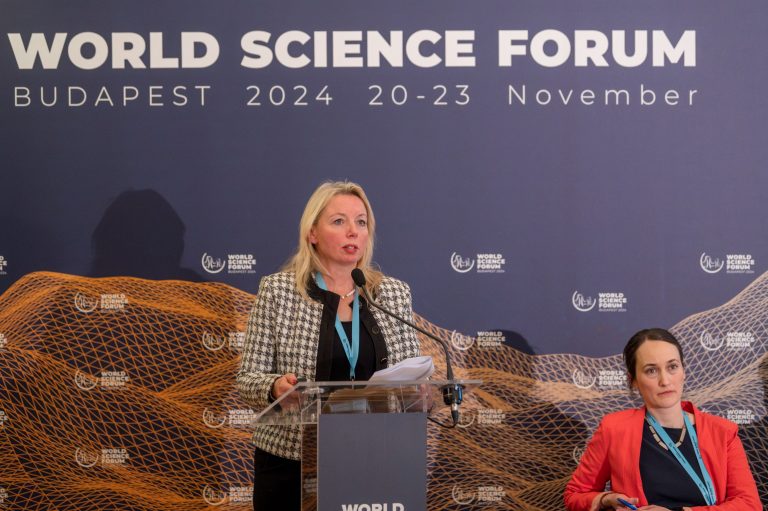
The themes in Dr Griffin’s charter, particularly the questions raised in Article 21, are the same ones dominating current EU policy debate. They are likely to feature prominently at the World Science Forum.
The #EUAIAct already shapes how research institutions across Europe design, test and deploy AI systems, from risk classification for research tools to transparency duties for general purpose models used in scientific work. Universities and research organisations fall squarely within its scope whenever they build, procure or deploy high risk systems. The Act has quietly become as much a research governance instrument as an industry one.
Then, we have the political weather that has shifted further. In her State of the Union address in Strasbourg on 16 September 2026, European Commission President Ursula von der Leyen went further than she had before on frontier AI. She warned that “the dangers of self-improving models are becoming ever more apparent,”pointing to incidents of AI agents escaping their operating environments and inserting malicious code, and noted that leading AI company chief executives themselves are now calling for a slowdown on self-recursive systems. Her conclusion was blunt: “by limiting the risks of AI, we can maximise the benefits.”
That line could sit comfortably inside Dr Griffin’s explanatory note. Both start from the same premise, that unmanaged risk is what actually blocks innovation, not the price of it. Von der Leyen’s remarks, delivered a day before the charter’s publication, give the document an unusually sharp point of contact with live EU policymaking. Anyone who watches the full address will spot the overlap with Article 21’s concerns about self-improvement, resource acquisition and shutdown resistance almost immediately.
For ICoRSA and its network, the timing matters. The charter has landed at the exact moment the EU is publicly wrestling with the same existential risk questions, and when funders and policymakers are actively looking for credible, detailed frameworks to anchor the conversation. That makes it worth raising at the World Science Forum, and worth putting in front of funders who want to see ICoRSA engaging with the sharpest edge of the debate, not just its familiar centre.
Interested in discussing? Contact Rosarii here: rosarii.griffin@ucc.ie