The International Consortium of Research Staff Associations (ICoRSA) convened its Annual General Meeting 2025 with a panel discussion on sustainable research careers, bringing together voices from the global research ecosystem. The event, chaired by Dr Rosarii Griffin, ICoRSA’s Company and Legal Secretary, showcased innovative approaches to addressing precarity, mobility challenges, and systemic barriers facing researchers worldwide.
Opening the Dialogue: ICoRSA’s Expanding Global Reach
Dr Gianna Avellis opened proceedings by highlighting ICoRSA’s growing international presence and strategic partnerships. She detailed the organisation’s participation in significant global events, including a reception attended by the President of Uzbekistan, who emphasised the country’s role in promoting cultural diplomacy, multilateral dialogue, and international cooperation. ICoRSA’s engagement with the Women 20 Inception Meeting in Cape Town demonstrated its commitment to addressing gender equality in STEM, with representatives focusing on education, digital divide, and climate justice.
Avellis also announced a significant development: the formation of a new Gender Equality Working Group, comprising Italian board members Dr Lucia Martinelli, Dr Sveva Avveduto, Dr Carla Petrocelli, and Dr Angela Agostiano, alongside ICoRSA members Dr Silvia Vilches and Dr Rosarii Griffin. This initiative aims to capitalise on ICoRSA members’ expertise, participate in international events, and lay the groundwork for future gender equality project applications. The announcement of research into generative AI for STEM education, published in the International Journal of Internet and Web Services, signals ICoRSA’s forward-thinking approach to addressing biases and stereotypes in STEM through technology.

Research Mobility: The Hidden Barriers Behind the Statistics
Dr Teresa Szybisty, Policy Officer at the Marie Curie Alumni Association (MCAA), presented compelling evidence from surveys involving approximately 2,000 respondents across 2022 and 2024. Representing a global community of over 24,000 members from 55 countries, the MCAA operates on three core pillars: networking, career development, and science policy. Szybisty emphasised that whilst the Marie Skłodowska-Curie Actions programme has supported over 150,000 researchers from 160 nationalities across 139 countries, the lived experience reveals significant challenges.
The data exposed troubling realities for mobile researchers. Over 25% of fellows reported that recruitment paperwork was confusing and unclear, whilst only half said visa processes were communicated effectively. Non-EU researchers face disproportionate challenges, with immigration problems being twice as common as for EU citizens. Additionally, over 38% of non-EU researchers in the EU reported serious immigration issues, with more than a third stating these problems directly limited their ability to conduct research.
Institutional support presented a mixed picture. Thirty percent rated onboarding as poor, whilst over 50% reported inadequate support for housing and family needs. Szybisty emphasised that mobility decisions affect not just individuals but their families, partners, and overall well-being, creating “invisible barriers that wear people down before they even start the research itself”.
Four Concrete Steps for Change
The MCAA, in collaboration with Eurodoc, proposed four achievable policy improvements:
- Enhance the Scientific Visa Directive: Implement faster, simpler, and more consistent visa procedures for researchers
- Establish European Research Contract Standards: Ensure clear, fair contracts available in English and host country languages
- Mandate R1-R4 Profile Use: Harmonise roles and career levels transparently across Europe
- Accelerate Qualification Recognition: Reduce degree recognition timelines following Lisbon Convention principles
Szybisty reported that the MCAA recently presented these findings at their first Policy Forum at the European Parliament, successfully bringing researchers’ voices directly to policymakers discussing the future Framework Programme 10.
Implementing the Research Career Framework: From Theory to Practice
Prof. Dr Erna Karalija from the University of Sarajevo introduced the SECURE2 project, a continuation of SECURE1, focused on implementing the European Research Career Framework. The framework, originally developed by the European Commission in December 2024 and revised by SECURE1, distilled over 120 actions into 8 manageable action areas encompassing 88 specific actions.
The Eight Action Areas
Dr Karalija explained that the framework addresses distinct dimensions of research careers:
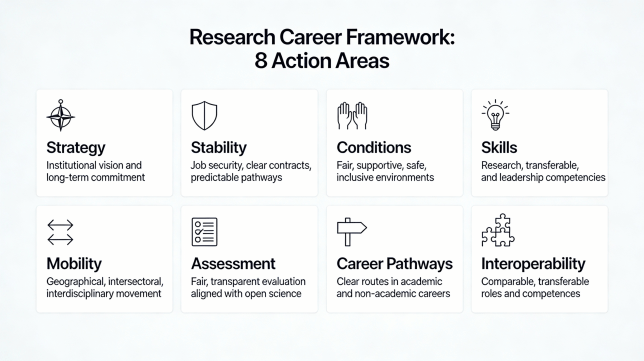
- Strategy: Institutional vision and long-term commitment to sustainable research careers
- Stability: Job security, contract clarity, and predictable career pathways
- Conditions: Fair, supportive, safe, and inclusive working environments
- Skills: Building research, transferable, and leadership competencies
- Mobility: Supporting geographical, intersectoral, and interdisciplinary movement
- Assessment: Fair, transparent evaluation aligned with open science and diverse contributions
- Career Pathways: Clear, inclusive structures for academic and non-academic careers
- Interoperability: Making researcher skills, roles, and competences comparable and transferable across institutions and sectors
The Implementation Process
SECURE2 employs an automated benchmarking tool that evaluates institutions across all action areas, assigning maturity levels from 0 to 4. Following self-assessment, the project conducts gap and needs analysis, recognising that identified gaps do not always align perfectly with institutional priorities. Through collaborative action plan co-creation with relevant stakeholders, including policymakers who may be unaware of required implementations, the project pilots interventions with mid-point checkpoints.
Dr Karalija emphasised that SECURE2 encourages pilots to tackle difficult implementations, not just easy wins, to capture genuine barriers and challenges. This evidence will inform policy briefs to the European Commission, making findings relevant for countries beyond the pilot institutions. With Carolina Varela managing the project, Karalija offered the tools, which will be freely available, to any interested institutions.
Postdoctoral Networks: Building Power Through Collaboration
Dr Tracy Wietecha and Dr Alvin Yang from the Max Planck Postdoc Network shared insights from their 2024 survey of 872 postdocs, revealing the international character of German research. Approximately three-quarters of Max Planck postdocs come from outside Germany, with almost half from outside Europe. Strikingly, 48% stated they knew no one before arriving in their German city, creating significant challenges for integration and support.
The Wissenschaftszeitvertragsgesetz Challenge
Dr Wietecha detailed the complexities of Germany’s federal law governing short-term academic contracts, which allows approximately six years for PhD completion and six years as a postdoc on short-term contracts. Whilst intended to reduce precarity, the law has created a “kicked out of science” scenario for those unable to secure permanent positions within these timeframes. The challenge is compounded by Germany’s federal structure, where change requires alignment at both federal and state levels.
Over half of postdocs are considering leaving Germany due to three main factors: family in another country, more attractive job prospects elsewhere, and language difficulties. Regarding future plans, nearly half expressed uncertainty or unwillingness to remain in Germany after employment.
Pay Scale Inequities
Dr Yang highlighted the Byzantine complexity of German pay scales, with separate systems (TVöD and TVL) operating at federal and state levels. Most postdocs are placed on pay grades E13 or E14, with levels 1-4 determined by work experience. A critical issue emerged: international postdocs are frequently placed at level 1 due to non-recognition of foreign credentials and experience, despite their qualifications warranting higher placement.
The Tri-Network Initiative: A Model for Collaborative Advocacy
Dr Yang presented the historic tri-network collaboration between Max Planck PostdocNet, Helmholtz Association Postdoc Network, and Leibniz Postdoc Network. Beginning with virtual meetings in May, the networks discovered remarkably similar challenges across Germany’s three leading research organisations. Their first in-person meeting in Mannheim in August 2024 marked a “historical moment,” leading to institutionalised quarterly meetings enshrined in network statutes.
This collaboration has already yielded results: joint appearances at each organisation’s annual meetings, engagement with German Parliament policymakers, discussions with the Federal Ministry for Research, Technology, and Space, and connections with political parties including the CDU and SPD. Yang emphasised that collective action creates momentum impossible to achieve individually, demonstrating that “together, this tri-network, we built a lot of momentum already”.
Dr Yang also presented data on scientific migration patterns, showing that whilst the United States historically attracted the most scholars, recent years have seen positive net scholarly inflows to both China and Germany, whilst the UK and France experience outflows. This underscores the importance of talent retention alongside attraction strategies.
Canadian Grassroots Advocacy: From Data to Policy Change
Dr Chanele Polenz, Chair of the Canadian Association of Postdoctoral Scholars (CAPS), demonstrated how volunteer-driven grassroots organisations can drive national policy change through evidence-based advocacy. CAPS recently completed its fifth national postdoctoral survey, collecting data from September 2024 to January 2025, providing crucial longitudinal insights post-COVID-19 pandemic.
Survey Findings and Impact
Dr Polenz shared encouraging trends: average postdoc salaries are increasing, though only 10% can save their desired amount. Professional development offerings show mixed alignment with postdoc needs, providing institutions with actionable data to improve their programmes. The top barriers to entering Canada remain financial hardship and visa/work permit issues.
Regarding retention, whilst the majority wish to remain in Canada, the percentage who are unsure has been steadily increasing. Significantly, whilst “better job opportunities elsewhere” as a reason to leave has decreased, “lack of support for research and development in Canada” has increased, pointing clearly to infrastructure investment needs.
Translating Data into Action
CAPS demonstrated how survey data functions at multiple levels. At institutional levels, researchers can advocate for salary increases and professional development improvements using national benchmarks. At the national level, CAPS partners with organisations like Support Our Science, which organised a 10,000-person walkout of graduate students, postdocs, and faculty that gained significant traction.
These efforts produced concrete results: the Federal Budget 2024 included the largest research funding increases in years, with the National Postdoctoral Fellowship nearly doubling from $40,000 to $70,000. The most recent federal budget allocated substantial resources to research infrastructure, including $1 billion over 13 years for Canada Research Chairs and $400 million over seven years for research infrastructure acquisition. Polenz concluded that data-driven advocacy creates powerful tools for change at all levels.
Research Management: The Invisible Profession Supporting Science
Dr Margarida Trindade, leading expert in research management from Nova University of Lisbon, introduced the newly adopted European Commission Research Management Competence Framework. Drawing on a 2024 survey of over 2,000 research managers, Trindade illustrated the diversity of professionals who facilitate research and innovation across the entire lifecycle.
A Profession Lacking Recognition
Research managers work across numerous areas: proposal development, project support, research strategy, policy development, science communication, ethics, integrity, collaboration, partnerships, infrastructure management, intellectual property, and research data. Remarkably, only 10% work exclusively in one area, with many professionals juggling 2-14 different areas. Additionally, 20% of respondents perform research management activities whilst holding other positions such as researcher, medical doctor, or teacher.
Dr Trindade highlighted that despite documented impact-showcased in a European Commission publication featuring 75 success cases-the profession suffers from lack of recognition across Europe. This creates risks: institutions without structured research management offices may underperform in funding, compliance, collaboration readiness, and innovation. The uneven distribution of research management expertise across Europe risks undermining the European Research Area’s vision of a borderless market for research, innovation, and technology.
The New Framework
Developed collaboratively by the European Commission, RM Roadmap project, Cardia project, and the research management community, the framework structures the profession into seven large competence areas, including “subject matter” which encompasses all the diverse roles research managers perform. Critically, the framework defines four proficiency levels-foundational, intermediate, advanced, and expert-mirroring the R1-R4 levels used in the researchers’ competence framework.
Trindade emphasised that the challenge now lies in adoption: encouraging institutions, individuals, countries, and member states to utilise the framework, and integrating it into European Union funding policy.
Addressing Shared Challenges
The roundtable discussion, moderated by Carolina Varela, revealed common threads across national contexts whilst highlighting unique challenges. Additionally, Dr Margarida Trindade questioned whether research management and research careers should maintain parallel frameworks allowing interoperability, or whether a unified framework encompassing all careers within the research ecosystem might better reflect their interconnectedness.
Dr Teresa Szybisty responded to questions about career diversification by emphasising that MCAA believes all career paths hold equal value, whether in academia, industry, entrepreneurship, or public service. She advocated for promoting placements and supervision in public administration and startups, recognising diverse career outputs in research assessment, and showcasing varied career journeys to build connections across countries and sectors.
Addressing concerns about Germany’s six-year postdoc limit, Dr Alvin Yang and Dr Tracy Wichicka acknowledged significant brain drain both internationally and to other sectors, particularly to private industry which often pays better, especially for STEM graduates. Additionally, they emphasised that disciplinary differences create varied needs: humanities scholars require years to write books, whilst some chemistry and physics postdocs transition after just one year to avoid difficulty securing industry positions later. They advocated for permanent positions for permanent tasks, particularly teaching positions, whilst noting that reforms towards departmental systems at institutions like Humboldt University Berlin and University of Hamburg could create more opportunities.
Dr Mikey Creane from ICoRSA praised MCAA’s data collection and asked about strategies for bringing solutions to decision-makers. Szybisty outlined their multi-pronged approach: publishing statements with partners, participating in the ERA Forum with direct policymaker connections, and engaging Members of European Parliament and the European Commission. The Policy Forum exemplified this strategy, with MEPs emphasising they need data described in actionable terms for policy development.
Rosarii Griffin noted an important comment from an attendee about the exhausting “treadmill” and “conveyor belt” of researcher life characterised by constant contract renewals and preparation time wasted between positions. She committed to providing a considered response to this emblematic case of research precarity.
Looking Forward: Four Pillars for Change
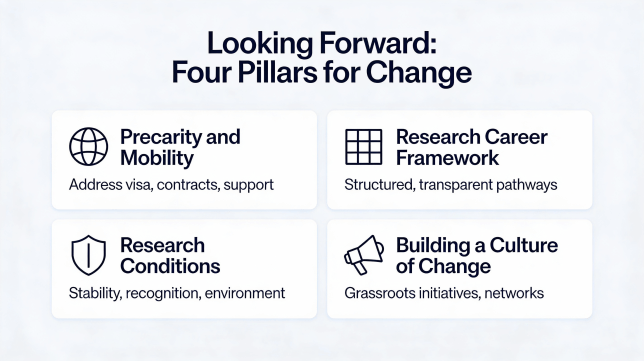
In closing remarks, Rosari Griffin synthesised the discussions into four core themes:
- Precarity and Mobility: Addressing visa challenges, contract clarity, and support systems
- Research Career Framework: Implementing structured, transparent career pathways
- Research Conditions: Improving stability, working environments, and recognition
- Building a Culture of Change: Leveraging grassroots initiatives and researcher networks for systemic reform
Dr Griffin emphasised that ICoRSA’s commitment to improving researcher careers globally depends on the kind of collaborative dialogue witnessed at the AGM. She thanked all speakers, attendees, and the wider ICoRSA community for their vital contributions to this shared goal.
Carolina Varela concluded by announcing that presentations would be shared with all participants, alongside a comprehensive wrap-up of the discussions. She expressed hope that the topics addressed would continue to feature prominently in European and international discussions, reflecting ICoRSA’s mission to empower researchers, connect communities, and shape the future of science through informed dialogue and systemic change.
The AGM 2025 demonstrated that while challenges facing researchers vary across national contexts, the solutions increasingly depend on international collaboration, evidence-based advocacy, and the collective power of researcher networks working together to transform the global research ecosystem.